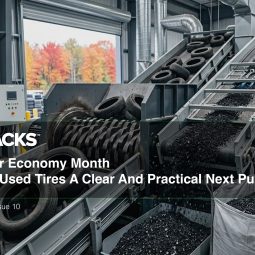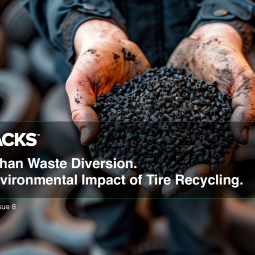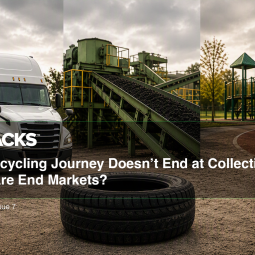
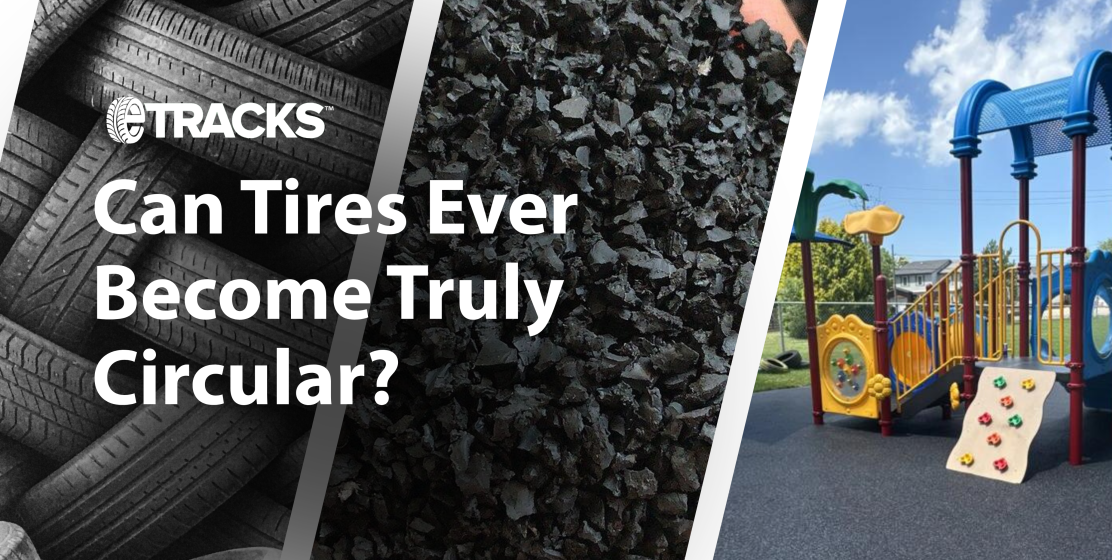
An end-of-life (ie. scrap) tire can become flooring in a hockey rink or fitness centre, cushioning in a horse or dairy barn, landscaping and construction materials, or even part of the road beneath your vehicle. In Ontario, eTracks helps transform millions of scrap tires into 50+ useful new materials and products each year.
That’s recycling and resource recovery. But is it circularity? Increasingly, the more interesting question is what happens after a tire’s second life.
If a scrap tire becomes a rubber livestock mat, what happens when that mat eventually wears out? Can its rubber be recovered again? Could materials from today’s tires ultimately find their way back into tomorrow’s tires or into another high value product?
Established scrap tire end markets are already giving recovered tire material productive second lives. In one of our recent blogs we spoke with Northwest Rubber, one of our local processing partners, that transforms recycled tire rubber into livestock and equestrian matting, sporting surfaces, automotive mats, anti-fatigue flooring and construction and landscaping materials.
Another important potential market is infrastructure. Our largest partner in processing scrap tires in Ontario is CRM Canada. CRM produces crumb rubber from recycled scrap tires that can be incorporated into asphalt (and many other products), creating a productive use for substantial amounts of recovered rubber. One lane mile of rubber-modified asphalt can use roughly 2,000 tires.
Every one of those applications keeps valuable material working. But eventually, those products reach the end of their lives too.
What happens to the second product?
Consider the livestock mat again. Technically, the rubber inside it may still have value, but recovering that value means someone must collect the used mat, transport it, clean it, process it and find another manufacturer willing to buy the resulting material. The barrier isn’t necessarily whether the rubber can be processed again. It’s creating the collection, logistics and market infrastructure needed to do it economically at scale.
Circularity isn’t simply a recycling technology – it’s a system. That system needs somewhere for recovered material to go, someone willing to use it, and an economically viable way to get it there.
Canada’s automakers are addressing this challenge with innovation
These aren’t questions unique to tires. Across the automotive industry, manufacturers are actively looking at end-of-life automotive parts not simply as having a beginning and an end, but as sources of materials that can remain in use again and again.
Let’s look at just a few examples from some of our customers, and members of the Canadian Vehicle Manufacturers Association (CVMA): Ford Motor Company, General Motors Canada (GMC) and Stellantis are each exploring ways to keep materials in productive use beyond a vehicles first life.
Ford, for example, has used recycled and renewable materials in vehicle components and has operated closed-loop systems that recover manufacturing scrap for reuse. Ford has also documented the use of recycled tires, post-consumer carpet and recycled plastics in vehicle applications, alongside closed-loop aluminum recycling intended to reduce reliance on primary materials.
Read more: Ford Motor Company – Moving Toward a Circular Economy
General Motors is experimenting with the idea in the design process. Its 2026 GMC HUMMER X concept uses recycled car fascias in interior components and explores mono-materials, mechanical fasteners instead of adhesives, and parts designed for easier disassembly – all intended to make materials easier to recover and repurpose.
Read more: General Motors Canada – GMC HUMMER X circular-design concept
Stellantis is taking another approach through its SUSTAINera circular-economy business. Its operations include dismantling end-of-life vehicles so usable parts can be recovered for reuse, while components that cannot be reused are directed to recycling streams. In one closed-loop initiative, aluminum recovered from post-consumer engines is processed into new aluminum ingots that return to manufacturing for use in new engines.
Read more: Stellantis – SUSTAINera expands its circular-economy and REUSE ecosystem
Different materials require different solutions, but the principle is the same: how do we retain as much of the original material’s value as possible instead of starting again with virgin resources?
Could an old tire eventually help make a new one?
For tires, perhaps the most ambitious version of that question is whether more end-of-life tire material can eventually return to tire manufacturing itself.
That is technically difficult. Tires are engineered to withstand tremendous heat, pressure, friction and repeated deformation. The properties that allow tire rubber to perform for thousands of kilometres also make it difficult to simply melt down and reform like some plastics or metals.
Researchers and companies are investing in technologies such as devulcanization, recovered carbon black and tire pyrolysis, each developed to recover materials from end-of-life tires at higher quality, with the goal of creating feedstocks that can be used in increasingly valuable applications, potentially including new tires.
The objective doesn’t need to be that every old tire becomes an entirely new tire. A more realistic circular economy may include multiple pathways: reuse and retreading where possible; recycled rubber in roads, flooring and manufactured products; recovery of carbon black, oils and other materials; and, as technology evolves, increasing amounts of recovered material returning to tire production.
Circularity needs markets as much as technology
Technology matters, but circularity also depends on something much less glamorous: functioning markets. Someone must want the recovered material.
Systems for tire recycling must be efficient, functional and stable. Manufacturers need confidence that recycled feedstocks will meet their quality and performance requirements. Collection and transportation must be economically viable. Processors need enough volume and demand to justify investment. Product designers need to consider what happens to materials at end of life. And governments, producers, recyclers and end users all influence whether markets for recovered materials can grow.
A rubber mat, hockey rink floor or kilometre of rubber-modified asphalt may not represent a perfectly closed loop. But each keeps material that already exists productive for longer and reduces the point at which that material finally becomes waste.
The second life doesn’t have to be the last
Ontario has already demonstrated that end-of-life tires don’t have to be waste and are a resource. The next evolution is figuring out how many times that resource can circulate. That means imagining things that don’t yet exist like new collection systems for products made from recycled rubber, or developing technologies capable of recovering increasingly high-quality materials from tires. Eventually, it could mean putting even more of those materials back into new tires.
Automakers are asking similar questions about aluminum, plastics, batteries and entire vehicle components. The common thread is a shift in thinking: the end of a product’s useful life doesn’t necessarily have to mean the end of the materials inside it.
A second life is a start. Circularity means finding the next one.