A growing number of used tires are finding a second life on the road. Adding recycled rubber to the asphalt mix for paving roadways comes with a range of perks for drivers and the environment while keeping end-of-life tires out of landfills. As the only not-for profit tire PRO in Ontario, eTracks hopes to see greater adoption of applications like rubberized asphalt, where an increasing volume of end-of-life are utilized in ways that are both economical and environmentally positive.
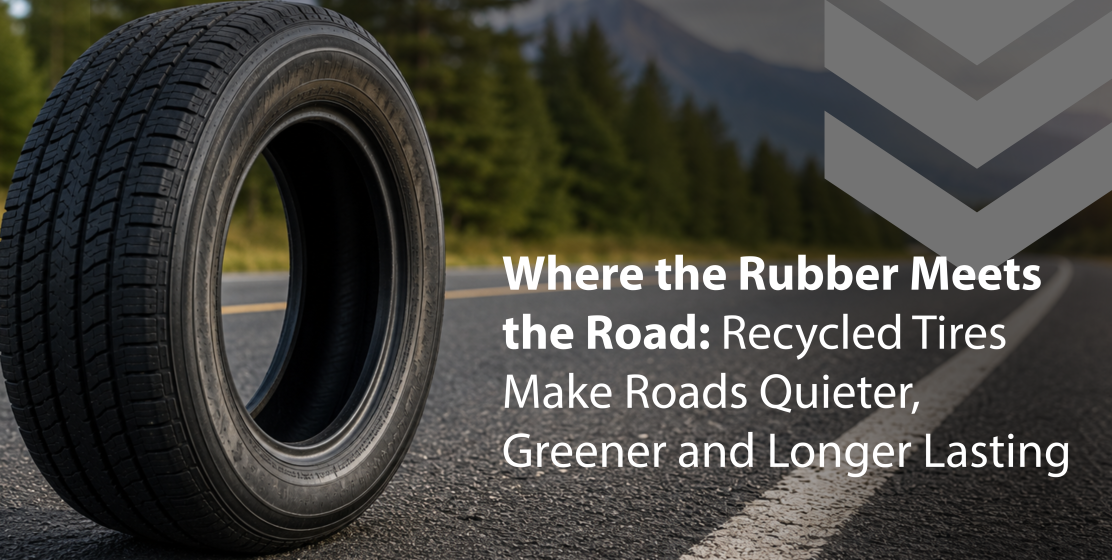
Rubber-modified asphalt made with tires is shown to reduce traffic noise, improve vehicle fuel economy, and create fewer lifecycle greenhouse gas emissions compared to conventional asphalt. It also provides a viable end market for the billion tires discarded annually around the world, reducing waste and eliminating the biological and ecological hazards posed by discarded tires.
“Rubber-modified asphalt is becoming a more common choice for roads because it not only gives you the same performance as virgin materials, but it also gives you that sustainability aspect,” said Sina Varamini, general manager at CRM of Canada, the largest crumb rubber producer in North America.
Across Canada, CRM sources tires from provincial stewardship programs, municipal collection sites and organizations like eTracks, a not-for-profit established to help tire producers meet the requirements of Individual Producer Responsibility (IPR) laws in Ontario, Canada’s most populous province.
“eTracks supplies significant volumes of end-of-life tires to CRM for recycling each year in Ontario, diverting millions of tires from landfills into a variety of end market materials and products,”, says Melissa Carlaw, VP Communications and Sustainability. While transit authorities have been slow to adopt rubber-modified asphalt, more are warming up to the idea.
How tires go from rubber to road
Asphalt is essentially the combination of two materials: aggregate particles and asphalt binder. The aggregate material (typically sand, gravel or crushed stone) makes up most of the mix, and the binder (bitumen, a byproduct of crude oil) acts as the glue that holds it all together.
This mixture works in some situations, but in others, it may not meet performance standards. “Depending on traffic rate or climate, the asphalt cement might not be able to perform as-is. It may need an enhancer,” Varamini explained.
Traditionally, that enhancer comes in the form of virgin polymers that strengthen the asphalt and give it a longer lifespan, but producers can also substitute crumb rubber made from 100 percent recycled materials.
CRM’s processing facility in Brantford, Ontario, is unique in that it produces crumb rubber in two ways. When tires enter the facility, they’re separated into their three primary components: steel, fiber and rubber. The rubber is ground into small particles using a mechanical shredder (known as ambient manufacturing), or frozen to extreme temperatures using liquid nitrogen and pulverized into a powder (known as cryogenic manufacturing), depending on how it will be used.
Different sizes of crumb rubber are best for different purposes. Coarser crumbs are widely used for sports surfaces and molded rubber products. But rubber-modified asphalt requires an extremely fine crumb called mesh that is most effectively produced through cryogenic manufacturing at facilities like CRM’s.
“Generally, coarser crumb rubber requires less processing and is therefore more cost-effective to produce. Finer crumb rubber requires more intensive processing and additional material separation, typically resulting in a cleaner, more refined rubber product,” Varamini said. “With rubber-modified asphalt, it’s typically anything finer than 600 microns [0.6 millimeters].”
Drivers can feel the difference: The perks and challenges of rubber-modified asphalt
One lane mile of rubber-modified asphalt repurposes around 2,000 tires. For drivers, the addition of recycled rubber creates a smoother ride, and reduced rolling resistance means better vehicle fuel economy and quieter roadways for surrounding communities.
“As someone who has spent quite a bit of time studying road materials, I can feel the difference profoundly,” Varamini said. “Rubber-modified asphalt can contribute to a quieter driving experience, depending on factors such as pavement design, surface texture, mixture characteristics, and traffic conditions. The elastic properties introduced by recycled tire rubber may help influence tire–pavement interaction and vibration response.”
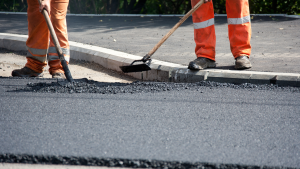 Rubber-modified asphalt typically lasts longer and requires less maintenance than other road materials, which translates to cost savings over the lifetime of the roadway along with an estimated 32 percent reduction in lifecycle carbon emissions.
Even with these benefits, the higher upfront cost compared to conventional asphalt and the learning curve that comes with new application methods has slowed adoption. “Due to the normalization of traditional asphalt, many government transportation departments prefer to continue using old materials and methods instead of new application processes, according to the Canadian Association of Tire Recycling Agencies (CATRA).
Adoption is slow but growing
While barriers exist, early adopters offer a compelling case. In the United States, California has used rubberized asphalt products for over 20 years and now has over 22,000 lane miles of rubber-modified asphalt roads in service.
The roads’ enhanced durability saved state agencies an estimated 20 percent on roadway construction and repairs, according to CRM, which supplies crumb rubber modifier to the California Department of Transportation.
Other U.S. states using rubber-modified asphalt include Arizona, Texas, Florida, Louisiana and Georgia. If you’re sensing a pattern of mild climates here, you’re spot on.
In northern states and Canadian provinces, frigid temperatures create additional engineering challenges to solve.
Anyone who’s ever driven past the same pothole over the course of a cold winter knows about the freeze-thaw cycle. As road ice melts in the daylight sun, water makes its way into crevices in the road surface. Overnight, the water expands as it freezes, putting pressure on the cracks and causing them to widen and break.
Rubber-modified asphalt can be a powerful ally to help roadways better withstand this seasonal cycle, as seen in chilly Ohio, but only when formulated and applied correctly.
Mixed results and durability problems in tests done decades ago in provinces like Ontario and Alberta, for example, slowed adoption elsewhere in Canada.
“There have been some bad experiences in the past that caused rubber-modified asphalt to not be implemented,” Varamini said. “This was a series of mistakes in the design of experiments, improper use of rubber in the roads, and overdosing the rubber.”
Now, however, understanding of the quality, quantity and size of crumb rubber needed for optimal performance has grown significantly, and provinces including Manitoba are taking rubber-modified asphalt beyond the pilot phase and into regular use. “With accurate construction, application and climate-specific mixtures … [rubber-modified asphalt] has proven to withstand colder areas,” CATRA found in a review of projects in Canada and elsewhere.
For his part, Varamini believes the tire recycling and road paving industries have a natural harmony. “Taking tires and translating that material into roads gives you two materials that are interacting and behaving in unison,” he said. “Isn’t that the ultimate enhancement of performance and service life?”